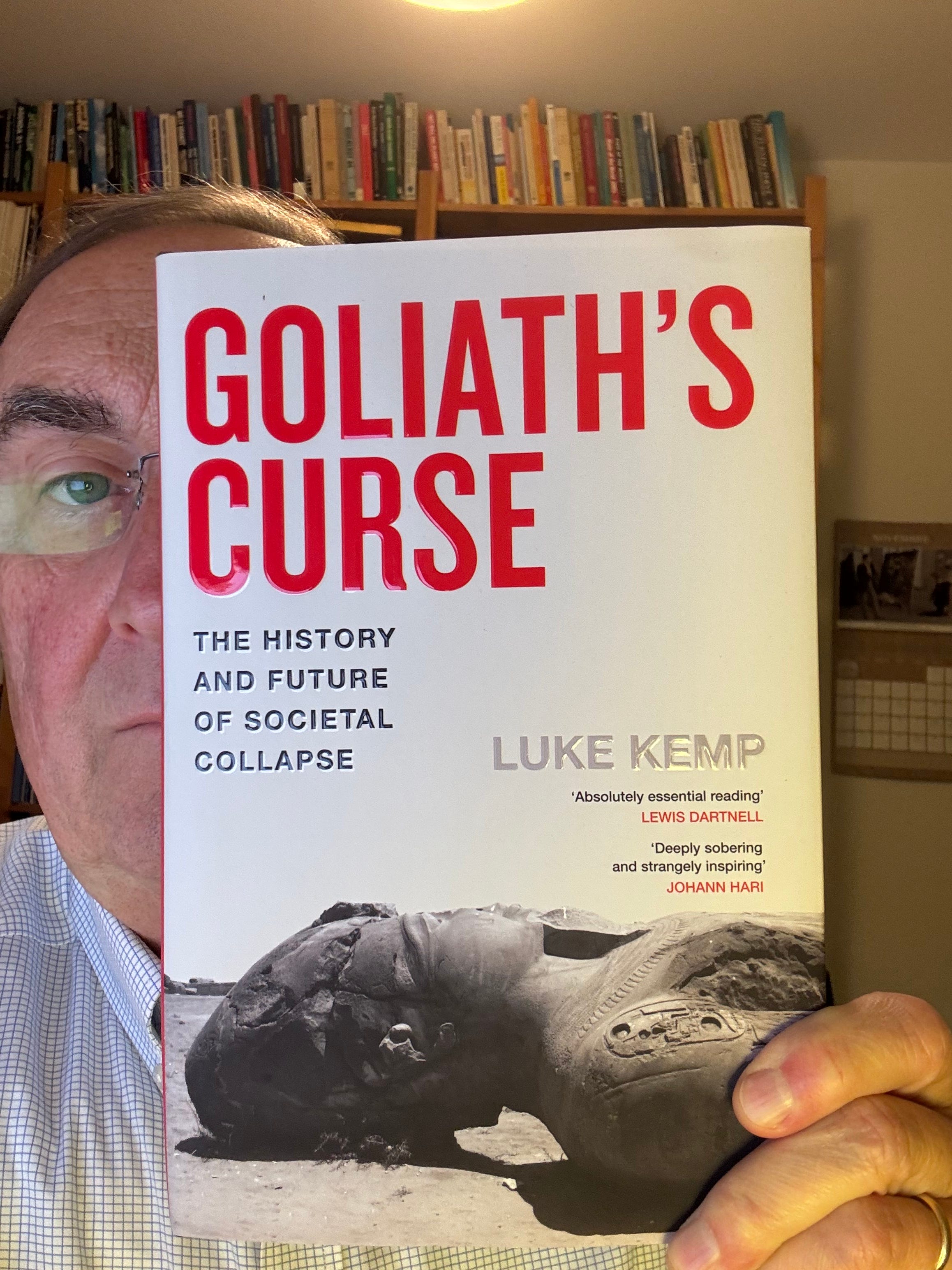
Reflections on Luke Kemp’s recent book “Goliath’s Curse”

Some time ago, some friends on Facebook reacted to the very interesting Guardian article on Luke Kemp’s recent book: “Goliath’s Curse – the history and future of societal collapse”. At that time I decided not to react. I felt I had to read the book first. I just finished, and I must say, I enjoyed every bit of it – though maybe “enjoy” is not the right expression about a book that closes with the idea that “The most likely fate of the Global Goliath [our globalized world of today] is self-termination.”
The book is a fascinating analysis – with lots of well documented examples - of some 5000 years of human history – which I will not attempt to summarize here. It is, however, amazing to see how human societies evolved over the hundreds and thousands of years. There were many collapses – followed by revivals. Some factors remain clear over the entire period of analyses, such as the role of inequality in causing violence, war and then collapse. The author is also very good at looking at historical developments, and then implicitly, and sometimes explicitly connecting them to today’s world.
Some selected key points I found particularly interesting:
· Kemp uses the term “Goliath” to describe collection of interconnected hierarchies in which some individuals dominate others to control energy and labour. The larger these Goliaths the increasingly unstable they become. As they grow, states accumulate layers of bureaucracy, elite privilege, extractive taxation, and rigid institutions. Over time these structures lose adaptability, making them vulnerable to shocks, internal decay, or legitimacy collapse.
· Hunter-gatherer societies were generally more egalitarian and resilient, traits that protected them from large-scale collapse and elite capture.
· Often in history, major improvements in technology and social organization helped the rich to get richer, but most of society went the other way. Introduction of agriculture to hunter gatherers resulted in less healthy diets and much more work. Same during the industrial revolution. In both cases, average heights of people went down, demonstrating that they got the shorter end of the stick.
· Human civilisation’s dominant pattern is domination and not linear progress, with societies ruled by elites, built on coercion, inequality, and control of land and labour – resulting in fragile societies going through cyclical rises and falls.
· “Goliath fuel” is the ecological and technological conditions that allow for the establishment of a Goliath, and which powers the rise of domination-based societies. These “fuels” include lootable resources (surplus/storable resources, like grain), monopolizable, concentrated weaponry, and caged land (geographical or political constraints that prevent people from leaving). When these fuels combine, hierarchical states tend to emerge.
· The deeper the inequality and the stronger the elite capture, the more brittle a society becomes. Concentration of power slows decision-making, suppresses innovation, and breeds corruption, ultimately fostering systemic failure.
· Societal decline, leading to collapse, is typically slow (over decades or centuries), systemic, and internal (political fragmentation, institutional ossification, economic and environmental stress) rather than a sudden, single dramatic event.
· Unlike past civilisations, humanity now shares an economically, technologically, and environmentally tightly integrated and hyperconnected global system – The Global Goliath - increasing the risk of a truly global collapse.
· While modern technology improves resilience in some ways, it also increases systemic risk: cascading failures, supply-chain dependence, cyber vulnerabilities, misinformation, and the potential for catastrophic misuse of AI or biotechnologies.
The book argues that inequality and elite dominance are the Achilles’ heel of large societies, and that unless the governance of our current “Goliath” is changed, we may face a catastrophic collapse of a scale never before seen.
“We’ll need to fight to escape Goliath traps. And that fight will need to be waged every day. Without that fight, our … Goliath is likely to take us on a path to either an unfree world or a global collapse …”
These last words of the book made me really worried about our future. But then, I noticed that there was an “epilogue” with lots of ideas from Kemp on “escaping the endgame”, recreating civilization”, and “becoming David” [against Goliath]. He argues that solutions lie in more distributed, participatory, and democratic governance; wealth taxation; citizen assemblies; and constraints on elite overreach. The more equal and adaptable a society is, the more resilient it becomes.
Doing all that will be really hard. But then, nobody said it will be easy. As he wrote in the last page of the book: “It won’t be easy, but anything worth fighting for rarely is. … It is worth doing the right thing even if the odds are stacked against us. …. We can’t rely on a deus ex machina like AI solving our problems. Real progress and an escape from Goliath’s Curse will come only from the battle to rebalance power. We can write a better story together. A story not about collapse or rise and fall. Rather, it would be a story of redemption. A story about rebuilding civilization.”
I hope you will get a chance to read this excellent book.
Couldn't agree more, your emphasis on inequality being a persistent factor in societal collapse throughout history really resonated, feeling like a foundational bug we're still debuging.